
01 / Mechanism
How does a closed-loop geothermal system work?
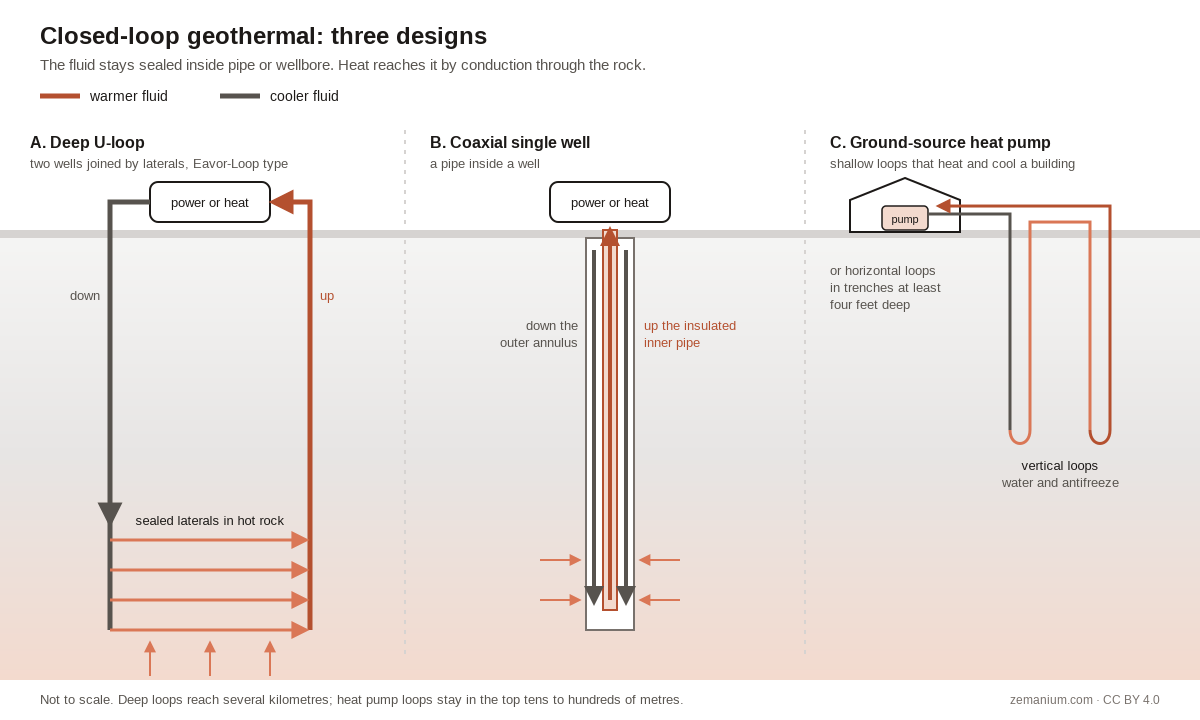
- A pump, or in a deep loop the difference in density between cold and hot fluid, drives the fluid down the inlet.
- The fluid runs through sealed wellbore or pipe in contact with warm rock, and heat conducts into it.
- The warmed fluid returns to the surface.
- At the surface it drives a power plant, usually an organic Rankine cycle, or a heat exchanger for district heating, or a heat pump in a building.
- The cooled fluid goes back down the same loop. It never mixes with groundwater.
Because heat arrives only by conduction, the output of a deep loop scales with the area of wellbore in contact with hot rock and with the temperature of that rock. That is why deep closed-loop designs drill long horizontal laterals, and why they gain so much from depth.
02 / Designs
What are the types of closed-loop geothermal systems?
| Design | Layout | Use | Example |
|---|---|---|---|
| Multilateral U-loop | two vertical wells joined by many horizontal laterals | power and district heat | Eavor-Loop at Geretsried, Germany, first power to the grid December 2025 |
| Coaxial | one well with an insulated inner pipe: fluid flows down the outer annulus and up the centre | heat, small power | modelled for thousands of designs in NLR and Sandia's 2023 closed-loop database |
| Conductive-material system | wellbore surrounded by thermally conductive material that draws heat from a wider volume of rock | power | XGS Energy: 150 MW agreement with Meta in New Mexico, announced June 2025 |
| Ground-source heat pump loop | horizontal, vertical or pond loops of plastic pipe near a building | heating and cooling buildings | by the Department of Energy's guide, the most common way to heat and cool with geothermal |
The companies behind each approach are in our guide to geothermal companies.
03 / Record
What Eavor's Geretsried loop produced.
Geretsried, in Bavaria, is the first commercial-scale closed-loop geothermal project. It sits on the site of an earlier conventional project whose wells found rock that was hot but dry. Eavor's technical update of 2026 gives these results, all company statements:
- Design: four loops of 12 lateral pairs each, for a nameplate of 8.2 MW of electricity or 64 MW of heat.
- Loop 1: six lateral pairs drilled and intersected at a measured depth of about 8,000 m, with four contributing to flow.
- Heat: about 8.5 MW, the output predicted for four pairs before drilling. Each pair produces more than 2 MW of heat now and is expected to settle at 1.3 MW after five years, the basis of the nameplate.
- Power: the Turboden organic Rankine cycle plant converts about 4.3% of the heat to electricity at the 11.8 MW average heat duty since start-up, because it is sized for the full four-loop project.
- Fluid loss: 0.5% to 2% of the circulating fluid, after sealing the laterals with Eavor's Rock-Pipe; about 0.1% expected in deeper basement rock.
- Lesson: cement behind the casing let fluid pass between the two drilling rigs, which forced one rig to work at a time and doubled drilling time and cost. Eavor has changed its cementing design for future loops and expects each new lateral pair to take about three weeks.
Eavor states that loops built this way are cost-competitive for European district heating in an average gradient of 30 °C per km, and that drilling deeper gives a path to electricity below $75 per MWh: in that gradient, it puts the output of a 15 km loop at 20 MW of electricity, against 2 MW at Geretsried.
04 / Cost
How much does closed-loop geothermal cost?
For heat, little; for electricity, it depends on how hot the rock is. NLR and Sandia ran millions of simulations for their 2023 closed-loop database. Their worked example is one U-loop:
| Input or result | Value |
|---|---|
| Vertical depth | 3,000 m |
| Horizontal lateral | 9,000 m |
| Rock gradient and bottom temperature | 60 °C per km, 205 °C |
| Water flow | 20 kg/s |
| Average heat output | 3.9 MW |
| Average electricity output | 285 kW |
| Drilling cost, at $1,000 per metre | $15 million |
| Levelized cost of heat | $31 per MWh |
| Levelized cost of electricity | $438 per MWh |
The same loop sells heat at a district-heating price and electricity at several times the $67 to $111 per MWh of a new conventional geothermal plant in Lazard's 2026 estimate, shown in our cost guide. Electricity from a loop gets cheaper with hotter rock, more laterals per well and cheaper drilling per metre. Our LCOE calculator shows how each input moves the price.
05 / Depth
Why closed loops need depth.
A loop collects heat only through its walls, so hotter rock pays twice: more heat flows in, and each kilogram of hot fluid carries more work. At 200 °C a kilogram can deliver 172 kJ of work at the wellhead; at 300 °C, 354 kJ. Across the world's measured continental land, rock reaches 200 °C at a median depth of about 8.5 km.
[MODEL] · IAPWS water properties and IHFC Global Heat Flow Database 2024 · 27 November 2026
Where that heat lies shallow is on our geothermal map, and how fast rock heats with depth is in our geothermal gradient guide.
06 / Heat pumps
Closed-loop geothermal heat pump systems.
Most people who search for a closed-loop geothermal system want to heat or cool a house. The US Department of Energy describes four ground-loop types; three are closed loops:
- Horizontal: usually the most cost-effective for homes, especially new construction with enough land. It needs trenches at least four feet deep.
- Vertical: used where land is limited or the soil is too shallow for trenches, with holes drilled into the bedrock. It can cost more but uses less land and disturbs less of the site. The holes run 100 to 400 feet deep, as our wells guide details.
- Pond or lake: the cheapest option where a large enough body of water is on site. The pipe coils sit at least eight feet below the surface to prevent freezing.
The fourth type, the open loop, pumps well or surface water straight through the heat pump and returns it to the ground. It works only with an adequate supply of relatively clean water and where local rules on groundwater discharge allow it. Geothermal heat pumps reach efficiencies of 300% to 600% on the coldest winter nights, use 25% to 50% less energy than air-source heat pumps, and last 20 years or more for the heat pump and 25 to 50 years for the ground loop, by the Department's guide.
07 / Compared
Closed-loop against conventional and enhanced geothermal.
| Closed loop | Conventional hydrothermal | Enhanced geothermal | |
|---|---|---|---|
| Fluid | sealed, recirculated | reservoir water produced and reinjected | water injected through fractured rock and recovered |
| Needs natural water and permeable rock | no | yes | no |
| Fracturing | none | none | hydraulic stimulation |
| How heat reaches the fluid | conduction through the wellbore wall | flow through the reservoir | flow through engineered fractures |
| Output set by | wellbore area and rock temperature | reservoir permeability and temperature | fracture area, flow and temperature |
| Example | Eavor, Geretsried, Germany | The Geysers, California | Fervo Energy, Cape Station, Utah |
How enhanced systems make a reservoir is in our enhanced geothermal guide, and how the surface plant turns heat into power is in our power plant guide. The environmental footprint of each is in our guide to the environmental impacts of geothermal energy.
08 / Questions
Common questions.
What is a closed-loop geothermal system?
A system that circulates a fluid through sealed pipe or wellbore in the ground and takes heat by conduction, with no water drawn from the rock. Deep loops make electricity and district heat; shallow loops feed geothermal heat pumps in buildings.
How does closed-loop geothermal work?
Cool fluid flows down one leg of the loop, warms as it passes through hot rock and returns to the surface, where it drives a power plant, a heat exchanger or a heat pump. The cooled fluid then goes back down the same sealed loop.
Is closed-loop geothermal better than open-loop?
For heat pumps, a closed loop works almost anywhere, while an open loop needs an adequate supply of clean water and permission to discharge it. For power, closed loops need no natural reservoir but produce less heat per well, so they rely on long laterals and hot rock.
How much does closed-loop geothermal cost?
In NLR and Sandia's 2023 worked example, one U-loop 3,000 m deep with a 9,000 m lateral delivered heat at $31 per MWh and electricity at $438 per MWh. Hotter rock, more laterals and cheaper drilling bring the electricity cost down.
Does closed-loop geothermal use fracking?
No. A closed loop takes heat by conduction through sealed wellbore and does not fracture the rock. Eavor states that its loops do not rely on fracking and use very little water.
Who is building closed-loop geothermal?
Eavor Technologies runs the first commercial-scale loop at Geretsried, Germany, sending power to the grid since December 2025. XGS Energy has a 150 MW agreement with Meta in New Mexico.
09 / Sources
Sources.
- Eavor Technologies, Technical update from Geretsried: what we built, what we learned, and what comes next, read 27 November 2026, and first electricity production at Geretsried, 4 December 2025. Company statements.
- K. Beckers, Y. Vasyliv, G. A. Bran-Anleu, M. Martinez, C. Augustine and M. White, Tabulated Database of Closed-Loop Geothermal Systems Performance for Cloud-Based Technical and Economic Modeling of Heat Production and Electricity Generation, NREL/CP-5700-84979, 48th Stanford Geothermal Workshop, 2023.
- US Department of Energy, Guide to Geothermal Heat Pumps, DOE/EE-0385.
- Office of the Governor of New Mexico, XGS Energy and Meta geothermal partnership, June 2025; XGS Energy, partnership with Baker Hughes, 2026. Company statement.
- Lazard, Levelized Cost of Energy+, 2026, as summarised in our cost guide.
- Zemanium, physics of deep geothermal power, flow exergy on IAPWS water properties, and the geothermal oracle depth model on the IHFC Global Heat Flow Database 2024, registered and time-stamped before the run, 27 November 2026. [MODEL].
Text, tables and the diagram on this page are licensed CC BY 4.0. Cite as: Toni Zemani, "Closed-loop geothermal: how sealed wells make power and heat", Zemanium, 28 November 2026.
All open models, records and drawings