
01 / Record
What the regulator's record shows.
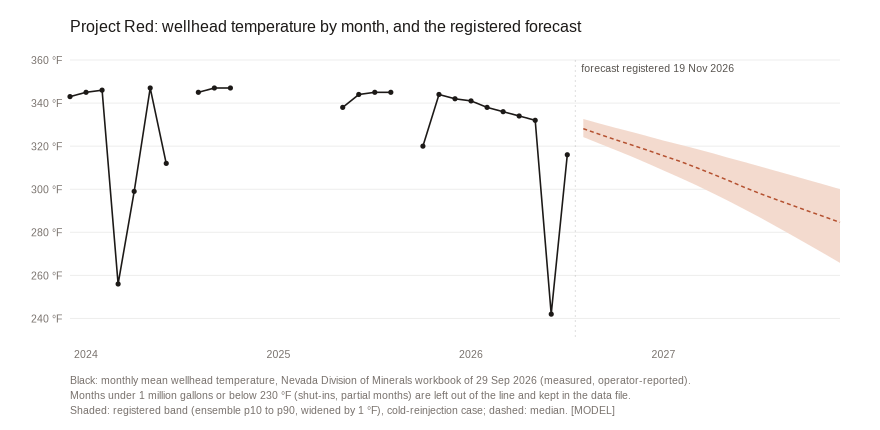
The producing well delivered 343 to 347 °F through most of 2024 and 2025. From December 2025 the monthly mean fell every month: 342, 341, 338, 336, 334 and 332 °F in May 2026. June read 242 °F in a month with 32% less production, and July read 316 °F.
| Month | Wellhead temperature | Produced, million gallons | Injection temperature |
|---|---|---|---|
| Aug 2025 | 345 °F | 19.8 | 174 °F |
| Sep 2025 | 115 °F | 6.4 | 58 °F |
| Oct 2025 | 320 °F | 20.6 | 171 °F |
| Nov 2025 | 344 °F | 24.4 | 170 °F |
| Dec 2025 | 342 °F | 25.6 | 171 °F |
| Jan 2026 | 341 °F | 25.7 | 171 °F |
| Feb 2026 | 338 °F | 24.0 | 172 °F |
| Mar 2026 | 336 °F | 25.8 | 168 °F |
| Apr 2026 | 334 °F | 25.0 | 86 °F |
| May 2026 | 332 °F | 26.7 | 92 °F |
| Jun 2026 | 242 °F | 18.2 | 75 °F |
| Jul 2026 | 316 °F | 22.8 | 86 °F |
The temperature of the water sent back down changed in April 2026, from about 170 °F to between 75 and 92 °F. Colder injection cools the fractures faster, so our forecast uses the cold-reinjection case from that month on.
02 / Forecast
What we forecast, and when it was fixed.
We fitted a conduction model of the fractured rock to nine steady months. It matches them with a root-mean-square error of 0.51 °F. Twenty-one model runs of 1,440 met that fit, and their spread sets the band. The forecast files were hashed and time-stamped by two independent authorities on 19 November 2026, before any of the forecast months were published.
- December 2026: median 318.1 °F, band 312.0 to 324.6 °F.
- July 2027: median 298.0 °F, band 286.9 to 310.6 °F.
- December 2027: median 284.6 °F, band 265.8 to 300.0 °F.
The model also says how much of the stated fracture area exchanges heat: 32% to 63% across the accepted runs. That figure decides how long a well pair of this design stays hot.
03 / Score
Score so far.
Each month is scored on the 7th after the regulator publishes it. The latest workbook, dated 29 September 2026, runs to July 2026, so the first forecast month is still to come.
| Month | Forecast median | Band | Regulator value |
|---|---|---|---|
| Aug 2026 | 328.1 °F | 324.2 to 332.6 °F | next regulator workbook |
| Sep 2026 | 325.5 °F | 321.2 to 330.5 °F | next regulator workbook |
| Oct 2026 | 323.0 °F | 318.2 to 328.5 °F | next regulator workbook |
| Nov 2026 | 320.6 °F | 315.2 to 326.6 °F | next regulator workbook |
| Dec 2026 | 318.1 °F | 312.0 to 324.6 °F | next regulator workbook |
04 / Water
How much water comes back.
Over 18 steady months, 72.7% of the injected volume came back up the producer, or 65.9% by mass. The ratio has not moved in 2.3 years: +0.2 points a year, plus or minus 1.5. Since December 2023 the pair took in 192.9 million gallons more than it returned.
05 / Questions
Common questions.
What is Fervo Project Red?
Project Red is Fervo Energy's first enhanced geothermal well pair, drilled at Blue Mountain in Humboldt County, Nevada. Its monthly production and injection are reported to the Nevada Division of Minerals under permits 1505 and 1506, which makes it the only enhanced geothermal production history in the public record.
Is Project Red cooling down?
Yes, on the regulator's monthly wellhead metric. The record held 344 to 347 °F in steady months from May 2024 to November 2025 and read 332 °F in May 2026 and 316 °F in July 2026.
Why is Fervo stock down?
Fervo Energy listed on Nasdaq as FRVO on 13 May 2026 after pricing its offering at $27 a share. A short seller report published in 2026 cited Project Red's temperature and water record. We checked 33 public claims about the well pair, from the short seller, the company and others, against the regulator's data; the audit is public and each verdict follows a written rule.
What does Project Red mean for Cape Station?
Cape Station in Utah uses a later well design at larger scale and reached first power on 24 September 2026, by the company's account. Project Red is the only well pair with a public monthly record, so it is the best public evidence for how fast this kind of reservoir cools. Our forecast F5 covers a Cape-class producer.
When is the next update?
On the 7th of each month after the Nevada Division of Minerals publishes a new workbook. Each update adds the new months to the chart and scores them against the registered band.
06 / Data
Data and tools for people and agents.
- Project Red monthly record (JSON) and registered forecast (JSON). CC BY 4.0.
- MCP server for AI agents:
https://zemanium.com/mcp. Tools return the record, the forecast, Nevada plant output and geothermal cost cases. - Forecast and audit repository: one command reproduces the fit, the water balance and the audit. DOI 10.5281/zenodo.24396505.
- Geothermal stocks: every listed producer, with the Nevada plant record.
Need a scorecard for another project? Write to toni@zemanium.com.
07 / Sources
Sources.
- Nevada Division of Minerals, Geothermal Production and Well Data, workbook of 29 September 2026. Measured, operator-reported.
- Zemanium, Forecast and audit record v1, registered 19 November 2026, doi:10.5281/zenodo.24396505.
- Fervo Energy, pricing of its upsized initial public offering, 12 May 2026. Company statement.
- Fervo Energy, first power at Cape Station, 24 September 2026. Company statement.
- Fervo Energy, two years of production data, 13 April 2026. Company statement.
Text, tables and figures on this page are licensed CC BY 4.0. Cite as: Toni Zemani, "Fervo Project Red: the monthly record against our registered forecast", Zemanium, 24 November 2026.
All open models, records and drawings